Start a build from Agents → Build with Conductor (next to New agent). To edit an agent you already have, see Refining an Agent.

The build form

A new build starts with a short form:
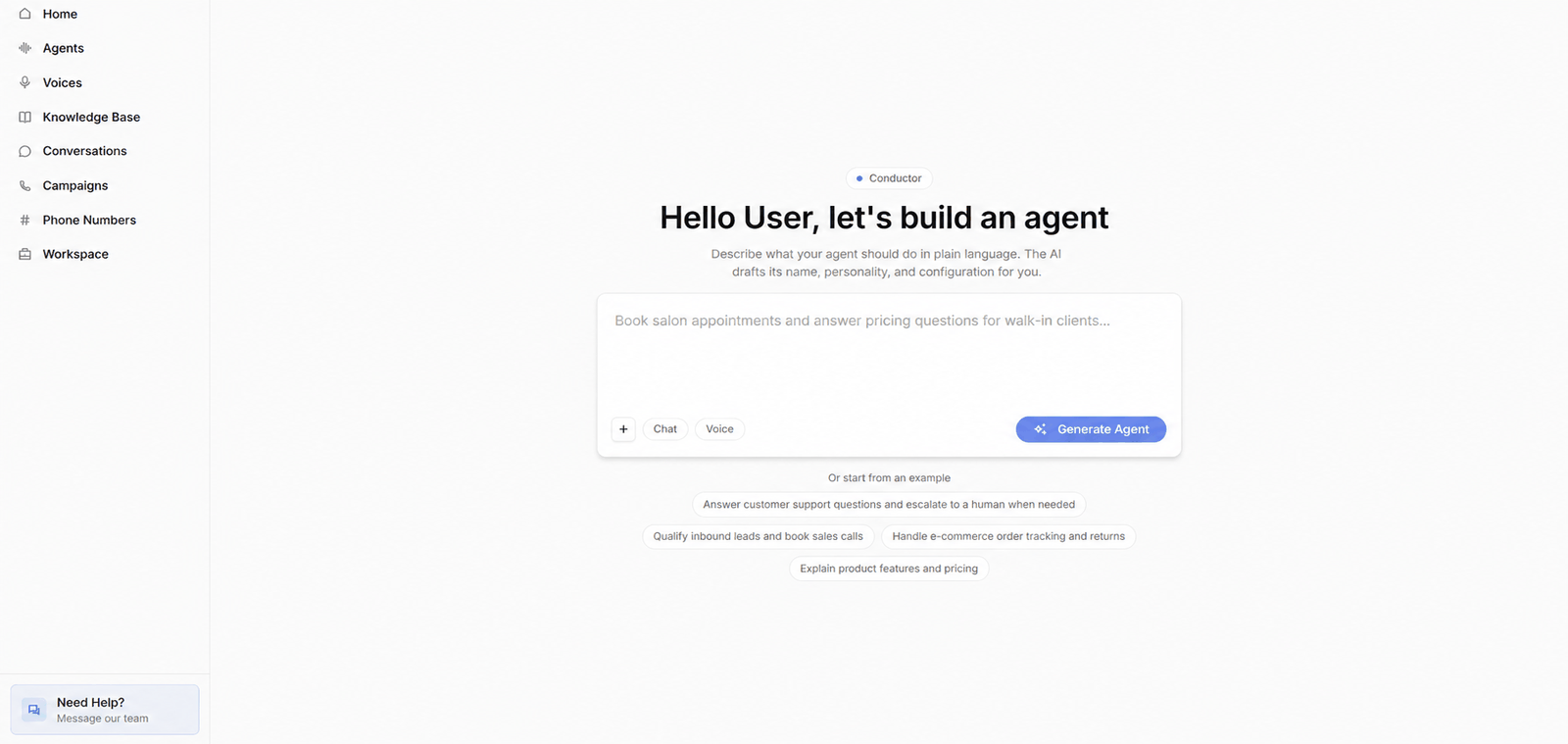
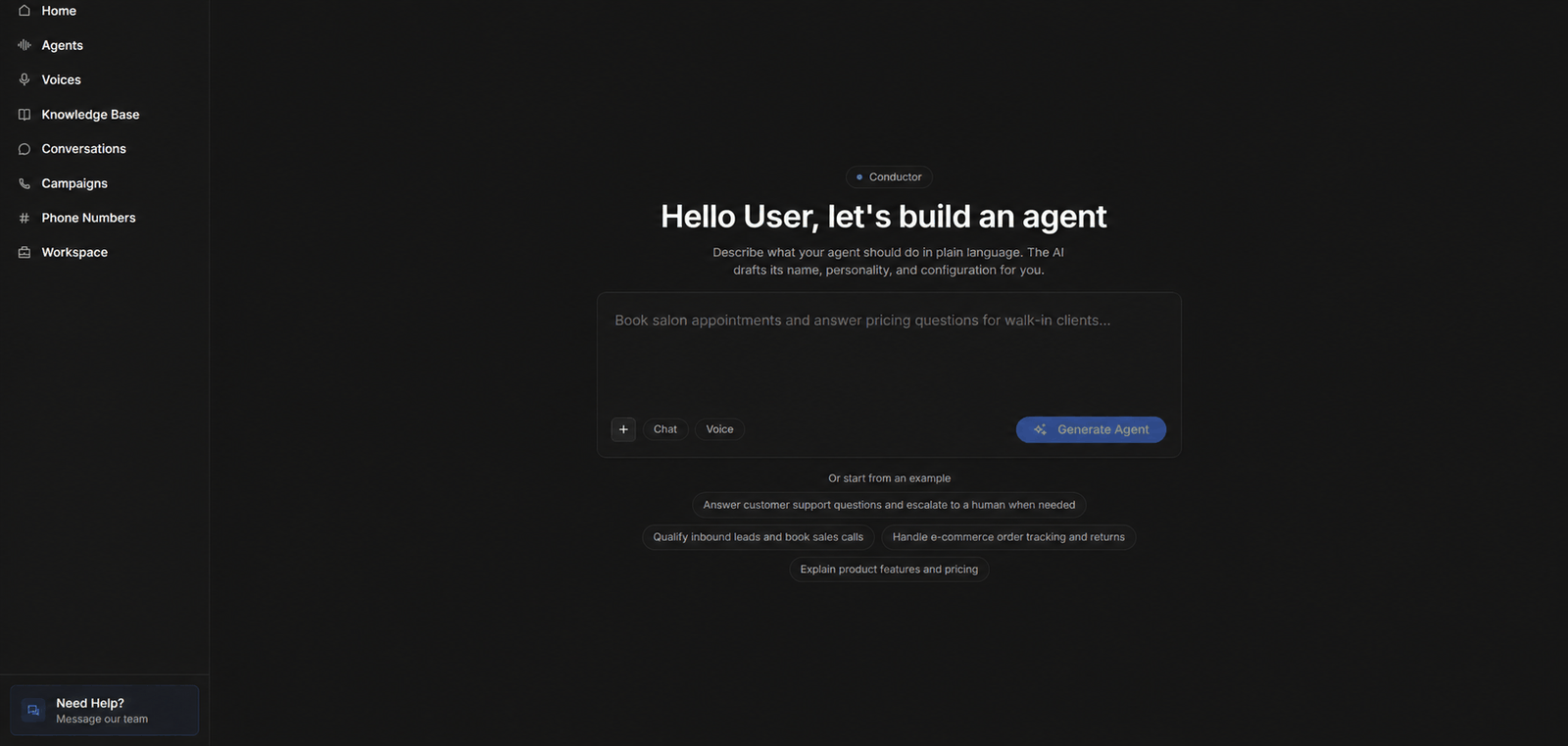
Conductor start screen with a description box, Chat and Voice options, and example promptsConductor start screen with a description box, Chat and Voice options, and example prompts
Click Generate Agent, or pick one of the examples under Or start from an example to prefill the description.
A good description names the business, the caller or customer, the goal, and when to hand off. “Qualify inbound leads for a solar installer, collect roof type and monthly bill, and book a site visit” gives Conductor far more to work with than “sales agent”.

Referencing an agent

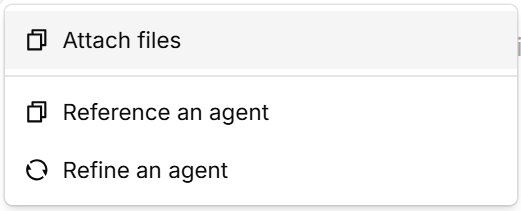
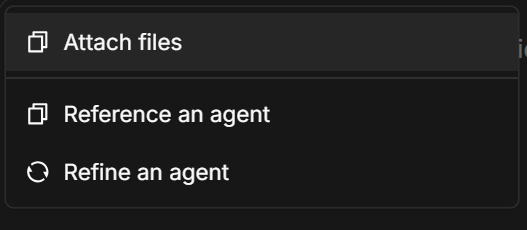
The + menu on the Conductor start screen with Attach files, Reference an agent, and Refine an agentThe + menu on the Conductor start screen with Attach files, Reference an agent, and Refine an agent
Referencing lets you base a new agent on one you already have. Pick it from + → Reference an agent, and the form shows Referencing: with the agent’s name (click × to clear it). Conductor copies the reference’s settings — model, voice, behaviour, and so on — but writes a fresh name, system prompt, and first message from your description. Custom tools and transfers from the reference arrive as review cards instead of being copied silently. You can also reference an agent from the other channel, such as a voice agent when building a chat agent: settings that don’t apply are dropped, and Conductor walks you through adapting the rest before you can create the agent. The reference agent must have a system prompt and can’t be archived.

Attaching files

Attach documents that describe your business — an FAQ, a pricing sheet, a call script — and Conductor uses them as context while drafting.
  • PDF, Markdown, TXT, or CSV (Word documents are not supported).
  • Up to 5 files per message, 10 MB each.
Files attached in Conductor are not added to your knowledge base, and the agent can’t search them after it’s created. To give the agent a document it can look things up in, upload it to the knowledge base first — Conductor can attach existing knowledge base documents to the agent.

Working with Conductor

After you click Generate Agent, the build page opens: the conversation with Conductor on the left and a live Preview of the draft agent on the right.
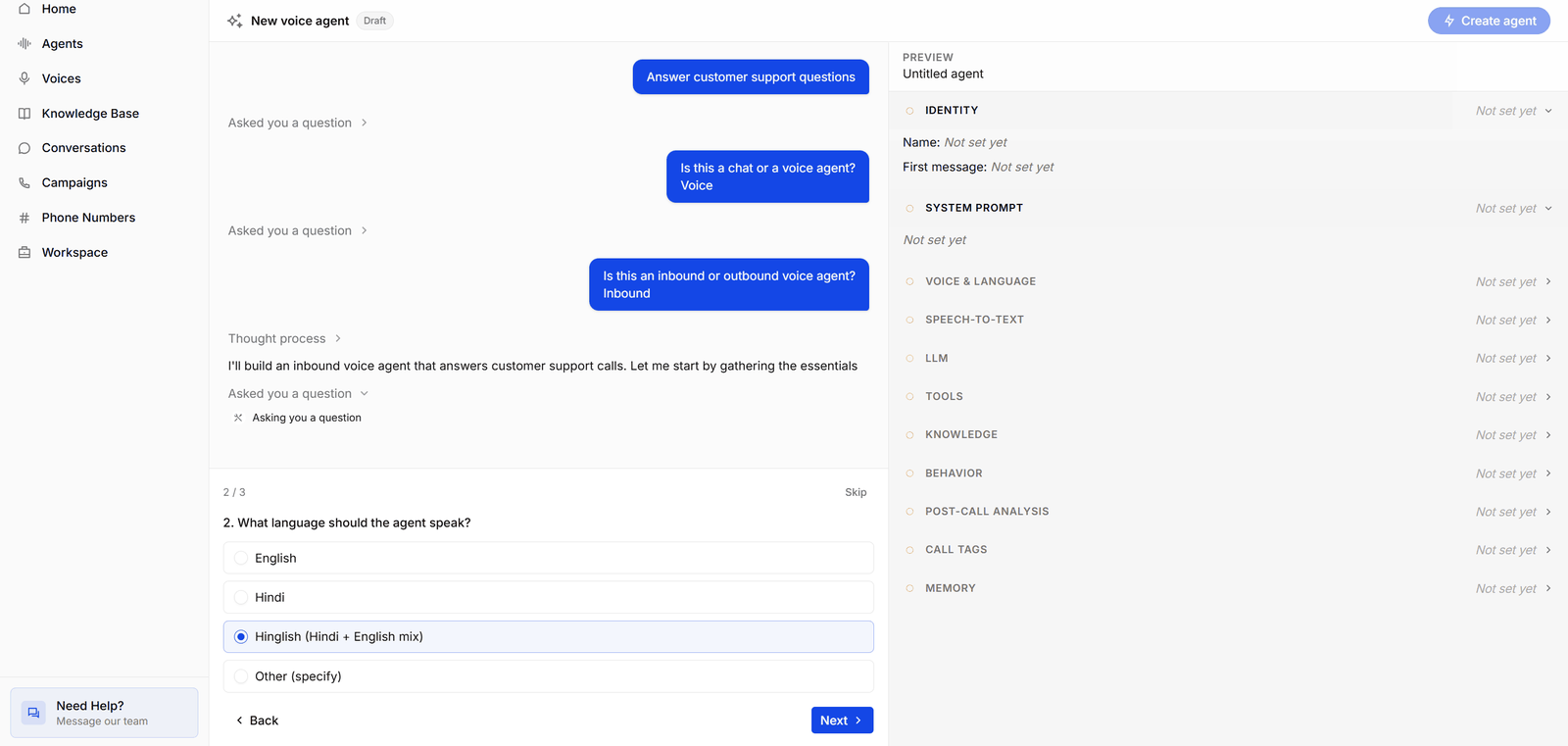
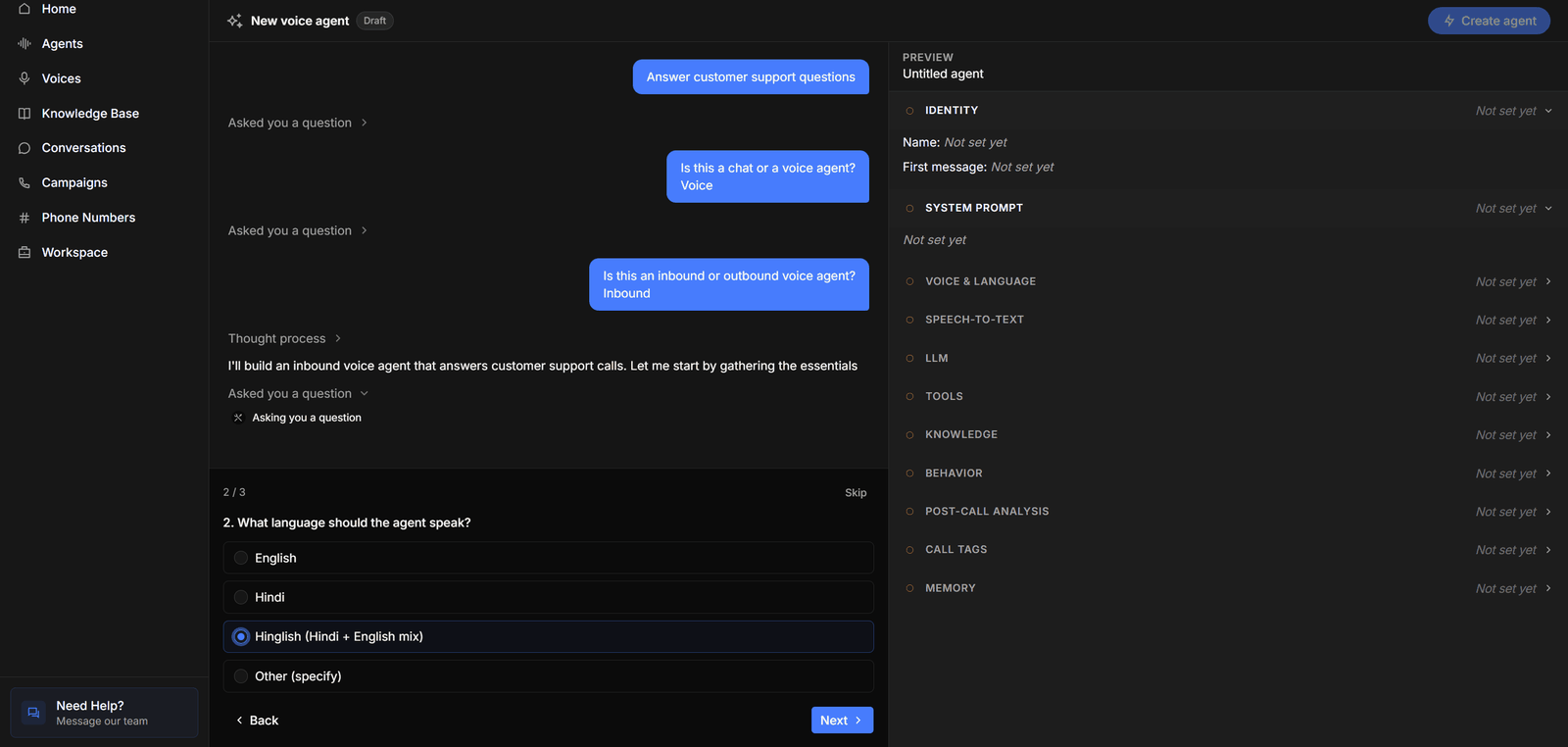
A voice agent build in progress: Conductor asking which language the agent should speak, with the Preview sections still unsetA voice agent build in progress: Conductor asking which language the agent should speak, with the Preview sections still unset
  • The header shows the agent’s name — New voice agent or New chat agent until Conductor names it — with a Draft badge, and the Create agent button, which stays disabled until the draft is ready.
  • The conversation shows your messages and Conductor’s replies. Conductor’s steps are condensed into short activity lines such as Asked you a question, Thought process, or Added 1 tool — click one to expand the details.
  • Questions replace the message box when Conductor needs details — above, it has already asked whether the agent is chat or voice and inbound or outbound, and is now asking which language to speak. Questions come one at a time (2 / 3 shows your progress); pick an option, or choose Other (specify) to type your own answer, and move between them with Back and Next. You can review your answers before submitting, and questions you leave unanswered are sent without an answer. Skip skips the whole set.
  • The Preview groups the draft into sections — Identity, System prompt (or Flow for multi-prompt agents), LLM, Tools, Knowledge, Behavior, and Memory, plus Voice & Language, Speech-to-text, Post-call analysis, and Call tags for voice agents. An amber circle and Not set yet mean a section hasn’t been filled in; a green tick means Conductor has set it. Expand a section to see its values.
Once the basics are in place, keep going in plain language — “make the tone more formal”, “add a transfer to our front desk”, “switch to Hindi”. Conductor applies each change to the draft and updates the Preview as it goes; you can stop it mid-response. Your draft is saved on the server as you go. A build can only be open in one browser tab at a time — if you open it elsewhere, the first tab shows This build is open in another tab with a Reconnect here button. When the draft is ready, review and create the agent.